Victor Ivan Remembered as Fearless Crusader for Press Freedom
- Editor
- February 26, 2026
- News, Political
- victor ivan
- 0 Comments
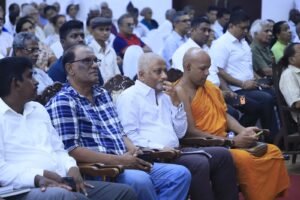
At a solemn ceremony to commemorate the life of veteran journalist Victor Ivan, senior journalist Hana Ibrahim gave a powerful tribute to a man she described as “a life lived in relentless pursuit of justice a life that does not simply end, but echoes.”
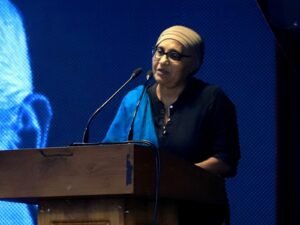
Speech by Hana Ibrahim
Many thanks to Janaranjana for helping me fill the gaps of Victor Ivans life
Distinguished guests, colleagues, friends — and fellow travellers in the cause of truth.
A life lived in relentless pursuit of justice is a life that does not simply end – it echoes. And the echo of Victor Ivan’s life is one that will ring through Sri Lankan journalism, through our courts, through our public consciousness, for generations to come.
Victor Ivan was one of the most remarkable figures this country has produced – not because he was perfect, and not because his path was straight, but precisely because it was not. His was a life of extraordinary courage, uncomfortable transformation, and a quality rarer still: the willingness to stand alone when standing alone was the only honest thing left to do.
To understand Victor Ivan, we must begin not at a desk in a newsroom, but in a prison cell.
Bear with me here for I am repeating what most of you already know….
Born in 1949, Victor entered public life not as a journalist, but as a young Marxist revolutionary – a member of the Janatha Vimukthi Peramuna, known within the movement as ‘Podi Athula’. He was deeply involved in the 1971 insurrection, arrested, tried, and imprisoned as one of its primary accused. At the time, he was a young man probably electrified by the conviction that the existing order was unjust and that armed struggle was the only path to justice.
But prison changed him. Not in the way that breaks people – but in the way that refines them. He read. He reflected. He interrogated the very ideology that had put him there. And somewhere in that cell, a profound transformation took place. He turned away from violence – not out of fear, not out of defeat – but out of principle. He came to believe, with the same intensity he had once brought to revolution, in the philosophy of non-violence and moral courage inspired by Mahatma Gandhi. The rebel became a reformer. The fighter became a journalist.
That inner journey – from insurrection to investigation, from ideology to integrity – was not a betrayal of his early convictions. It was their evolution. And it shaped everything that followed.
Ravaya
In 1986, against a backdrop of political turmoil and violent insurrections, Victor Ivan founded Ravaya – first as a magazine, then as the bold, uncompromising newspaper it would become. He would serve as its editor for twenty-five consecutive years.
Twenty-five years. Think about what that means. Through the second JVP insurrection. Through the bloodiest years of the civil war. Through governments that imprisoned journalists, through institutions that threatened and cajoled, through legal cases that were brought not to seek justice but to silence. Through all of that – he continued to publish.
Ravaya, under his stewardship, was not simply a newspaper. It was a space of dissent in an era when dissent was dangerous. It was a platform for scrutiny when scrutiny could cost you your liberty, or your life. It was proof, published weekly, that independent journalism was not only possible in Sri Lanka – it was necessary.
And the journalism was not merely brave. It was rigorous. Victor was not a man who confused recklessness with courage. He gathered evidence. He tested claims. He understood that truth, to be effective, must also be defensible.
Let me tell you about some of what he did – because the specifics matter. Abstract praise is easy. The details are where the man truly lives.
In 1986, when radioactive milk powder from post-Chernobyl Europe was being imported into Sri Lanka without adequate testing, Victor Ivan ran the story. The government had failed to act. The company involved -Nestlé – threatened legal action. Victor did not back down. He sent samples to Japan for independent testing, confirmed the contamination, ran a front page with a satirical twist on the company’s own advertisement, and forced the matter into public view. When faced with legal pressure, the evidence was so solid that the threat evaporated.
He published lists of powerful businessmen and politicians whose millions of rupees in debts to state banks were simply being written off, debts that the public would ultimately bear. He named names. He included, without flinching, the brother of the President’s own legal advisor.
When a magistrate sexually abused a woman whose case was before him, and when her husband, who protested in court, was brutally assaulted by court staff and hospitalised, Victor was one of the very few journalists to report it. Despite pressure, despite the involvement of senior legal figures who sought to suppress the investigation, he persisted. His reporting eventually contributed to a landmark committee finding that judge guilty of misconduct.
When the actor Kamal Addararachchi was acquitted of a rape charge by a magistrate who claimed a sixteen-year-old girl had given “implied consent”, every major media outlet stayed silent. Victor Ivan did not. Ravaya challenged the ruling publicly and persistently. The Attorney General was moved to take the case to the High Court. The actor was eventually convicted and sentenced to prison. That conviction exists, in no small part, because one editor refused to look away.
These were not stories that won him friends in powerful places. They were stories that won him enemies. And I believe he collected those enemies with something approaching pride.
Of all the battles Victor Ivan fought, none was more consequential, or more personal, than his long confrontation with the judiciary. And at the heart of that confrontation stood one figure: Sarath N. Silva.
Victor had reported extensively on misconduct involving Silva when he was serving as Attorney General. He had documented allegations of bias, of improperly suppressed investigations, of judicial decisions that appeared to serve private interests. He had filed petitions. He had built a public record.
And then, despite all of this, despite pending petitions that had not been resolved, despite the weight of documented evidence, then President Chandrika Kumaratunga appointed Sarath N. Silva as Chief Justice of Sri Lanka. The most senior judge in the country was bypassed. The appointment was made.
Victor Ivan’s response was one for the history books.
The next edition of Ravaya ran a black-bordered front page. On it was a photograph of the swearing-in ceremony. The photograph was printed upside down. And the headline read, in Sinhala: Adhikarana Nidahase Malagama – ‘The Funeral of Judicial Independence’.
It was an act of extraordinary editorial courage. It was also an act of exquisite journalistic clarity. No reader could mistake the message. No institution could pretend the challenge had not been made.
He filed fundamental rights petitions against the appointment. He requested that a full bench of senior judges hear the matter, to ensure impartiality. Instead, the Chief Justice used his own authority to appoint a bench of junior judges to hear petitions filed against himself, a manoeuvre that effectively silenced the most senior voices in the court.
When impeachment motions were eventually brought against the Chief Justice in Parliament, motions grounded substantially in the evidence Victor had spent years making public, President Kumaratunga used her executive powers to suppress them.
The battle, as it has been noted, was ultimately unfinished. Justice, in the formal sense, was not delivered. But the record was made. The courage was demonstrated. And in a country where the powerful had long relied on the silence of the press, the silence had been broken, – loudly, permanently, and on the front page.
UN Human Rights Committee
The state filed eleven criminal defamation cases against Victor Ivan. Eleven. When the Supreme Court ruled that this was not oppressive, Victor did not accept the verdict as final. He took his case to the United Nations Human Rights Committee in Geneva – becoming the first Sri Lankan to do so.
The Committee ruled that the Sri Lankan state had violated his rights. That ruling contributed directly to the eventual total abolition of criminal defamation laws in Sri Lanka, a legal reform that has protected every journalist in this country who has reported on power since.
Victor Ivan did not merely report on the law. He changed it.
Those who knew Victor Ivan closely would tell you that he did not simply believe in courageous journalism, he believed in principled journalism. The distinction mattered enormously to him.
At Ravaya, he established a ten-point code of ethics that was printed and displayed at the entrance to the office. Journalists were committed to truthfulness and honesty. To impartiality, regardless of personal sympathy. To a higher standard of privacy protection for ordinary citizens than for public figures, a remarkable inversion of common media practice. To refusing bribes and resisting all forms of corruption.
This was not a set of aspirational phrases on a wall. It was a lived standard, enforced by an editor who held his staff to it and held himself to it first.
He was also, by any measure, a genuine intellectual, though he would likely have resisted the title. He never mastered English formally, but he built a vast personal library, studied English academic works, and translated them into Sinhala so that the wider public could access sophisticated social and political analysis. He moved away from ideology toward data, relying on statistics and evidence to give readers not just his conclusions, but the tools to reach their own.
He was described by some as a ‘Public Intellectual’ whose influence rivalled that of traditional academics. I think that is exactly right. He shaped how Sri Lankans thought about politics, justice, and accountability in ways that no university syllabus had managed to do.
The Man
I want to say something about the man, not just the journalist.
Victor Ivan was not an easy person. Those who worked alongside him will tell you that readily. He possessed what his colleagues described as an extreme rigidity, a harshness of manner in both his personal and social life that often cost him relationships and caused friction with those around him. In 2018, a significant group of senior journalists left Ravaya following a serious professional rupture and went on to found a new publication, Anidda. The split was real, and it was painful.
And yet, those same colleagues, in speaking of him now, speak of the light he lit in journalism, and of carrying that light forward. That tells you something important. The man could be difficult. The mission never was.
There is something else worth knowing. To those who were closest to him, those who moved past the public persona of the fierce, uncompromising editor, there was a deep kindness. A warmth that coexisted, somehow, with the ferocity. He was, by the accounts of those who loved him, a deeply nurturing father. The gentleness he rarely showed in public was not absent. It was reserved, perhaps, for the people who had earned it.
Victor Ivan’s political journey attracted controversy, particularly in his later years. His roots were in the revolutionary left; his later political positions were read by many as a drift toward the establishment. Critics from the progressive camp were particularly wounded by his refusal to support their movement and his apparent alignment with Ranil Wickremesinghe.
I think it is worth addressing this honestly.
Victor himself said, and those who knew him confirm, that he did not value public opinion for its own sake. He changed his positions based on what he honestly believed to be right at any given moment, not on what was popular, not on what preserved his reputation, and certainly not on what kept his old allies comfortable.
A significant marker of his later alignment was the abolition of criminal defamation laws in 2002, under then Prime Minister Ranil Wickremesinghe as part of the United National Front (UNF) government. Free Media Movement (FMM), which campaigned for nearly a decade for repeal, hailed it as a major victory.
This was the culmination of a battle Victor had fought for decades at enormous personal cost. That the legal reform he had sacrificed so much to achieve came through a government led by someone he had publicly clashed with did not diminish the achievement. It complicated it, for him, and for others. But complexity, for Victor Ivan, was never a reason to look away from the truth as he saw it.
A life of counter-currents, as those who knew him best described it. He swam against the tide his entire life. Sometimes that meant challenging governments; sometimes it meant challenging his own former allies. The direction changed. The willingness to swim against the current never did.
Victor Ivan received the National Integrity Award from Transparency International Sri Lanka in 2015 – recognition from an institution devoted to accountability of a life devoted to the same cause. His books, including Chaurya Rajina and Pansale Viplawaya, remain essential reading for anyone seeking to understand Sri Lanka’s political history. His legal battles rewrote the laws under which journalism is practiced in this country.
But the most important thing he leaves behind cannot be measured in awards or legislation.
He leaves behind a standard. A demonstration, lived out over decades, at real personal cost, of what journalism can be when it refuses to flinch. When it chooses evidence over access, accountability over comfort, the public interest over the interests of the powerful.
He leaves behind a generation of journalists who learned, from watching him, that truth-telling is not merely a professional skill. It is a moral commitment. A calling. A promise made, implicitly, to every reader who picks up the paper and trusts that the person who wrote it was trying to tell them the truth.
Victor Ivan was seventy-five years old when he died. He had lived as a rebel, as a prisoner, as a thinker, as a writer, as an editor. He had been threatened, taken to court, fought in Geneva, and fought again at home. He had changed laws. He had challenged Chief Justices. He had stood on the steps of institutions that sought to silence him and insisted, again and again, that the public deserved to know.
He was not, I repeat, a perfect man. The legacy of anyone who lived as fiercely as he did is bound to be complicated. But complication is the territory of the honest. Simple legacies belong to people who never took risks.
What is not complicated, what is clean and clear and beyond dispute, is that Sri Lanka is a different country because Victor Ivan lived and worked in it. Journalists are freer. Laws are fairer. The public record of our political history is more honest. And somewhere in every newsroom where a reporter is deciding whether to run a difficult story, the spirit of his example is present.
That is not a small thing. That is, in fact, everything.
May we carry his work forward. May we deserve the freedom he helped to secure. And may we have, when our own moments of difficulty arrive, even a fraction of his courage.