Colombo Port City’s FDI Test Begins with First Residential Project Progress
- Editor
- January 27, 2026
- Business News, News
- Colombo Port City, Port City
- 0 Comments
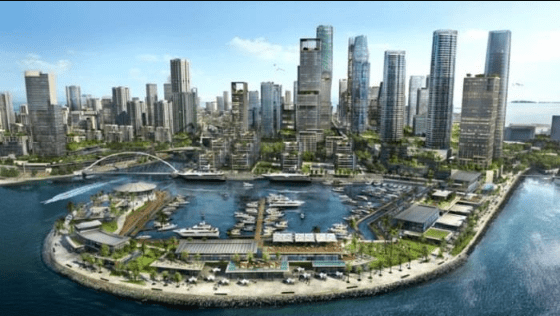
The launch of construction at Colombo Port City’s first residential development is being hailed as a turning point, but beneath the optimism lies a more complex investment story still unfolding.
Bay One Residences Colombo, a US$112 million luxury apartment project developed by ICC Port City Ltd., has become the first private-sector residential venture to move from approval to execution within Sri Lanka’s flagship SEZ. The milestone represents tangible progress after years of regulatory preparation, infrastructure development, and institutional design.
Port City’s first phase infrastructure is now largely complete, enabling developers to proceed with confidence. For policymakers, the project demonstrates that the legal and operational environment is finally investable. For the private sector, it offers a proof of concept that the SEZ is no longer theoretical.
Yet the nature of the investment itself highlights an important distinction. While Bay One reflects strong domestic private-sector participation, it does not yet represent the scale of foreign capital inflows originally envisioned when Port City was positioned as a regional financial and services hub. The broader FDI pipeline particularly from global financial institutions and multinational service providers remains in early stages.
Located on a prime waterfront site, the 231-unit development is aimed at high-end buyers seeking integrated live-work-lifestyle options. ICC’s leadership has framed the project as a foundational element of Port City’s mixed-use ecosystem, leveraging the firm’s 45-year track record in large-scale construction.
The project’s launch was attended by senior Government and Port City Economic Commission officials, reinforcing its strategic importance. CHEC Port City Colombo’s management emphasised that this moment marks the city’s transition from planning to physical formation a critical credibility test for any mega-urban development.
However, challenges remain. Attracting sustained FDI requires more than regulatory clarity; it demands macroeconomic stability, predictable policy execution, and regional competitiveness. Port City’s ability to convert land leases and interest into operational businesses will define its success over the next decade.
Bay One’s construction is therefore less an endpoint than a beginning. As the first residential structure rises, investors will closely monitor whether additional projects commercial, financial, and export-oriented follow at scale.
For Colombo Port City, the real measure of success will not be the completion of its first tower, but whether this milestone triggers a self-sustaining cycle of investment that justifies the project’s original ambition to transform Sri Lanka into a regional investment destination.

